Azawakh
Azawakh: Temperament, Care, Health and Everyday Life
The Azawakh is an elegant African sighthound originating from the Sahel region of West Africa, with Mali recognised as its country of origin. For centuries, these exceptionally lean and athletic dogs lived alongside nomadic peoples of the South Sahara, serving as companions, valued dogs and hunting hounds. Their distinctive background has shaped a breed that combines speed, endurance, independence and a particularly strong attachment to trusted members of its social group.
Although the Azawakh’s extremely slender appearance may initially attract attention, prospective owners should look beyond its unusual physique. This is an intelligent, sensitive and often reserved breed with specific socialisation, training and exercise requirements. Understanding its temperament is particularly important because an Azawakh may behave very differently with its own family than with unfamiliar people.
How big does an Azawakh get?
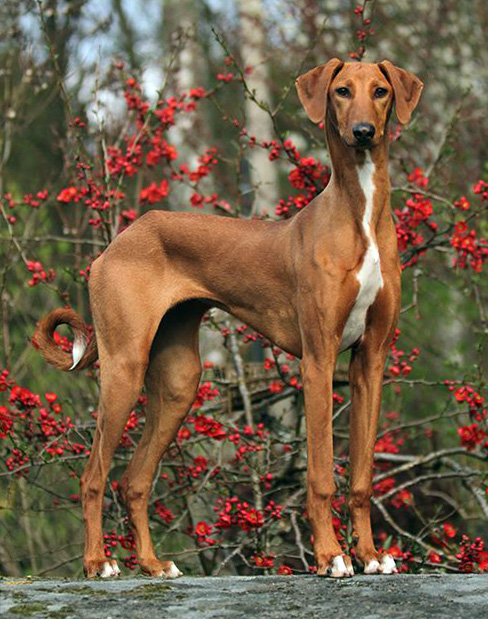
The Azawakh is a tall, exceptionally slender sighthound. According to the breed standard, adult males typically measure between 64 and 74 cm at the withers and weigh approximately 20 to 25 kg. Females generally measure between 60 and 70 cm and weigh approximately 15 to 20 kg.
Despite their height, Azawakhs are surprisingly light. Their fine bone structure, lean musculature and minimal body fat give them a distinctive appearance in which the outlines of muscles and bones may be clearly visible. This naturally lean build should not automatically be mistaken for being underweight.
At the same time, body condition should be assessed individually. Sudden weight loss or other physical changes should not simply be attributed to the breed’s naturally slender appearance and may require veterinary evaluation.
How long do Azawakhs live?
Azawakhs generally have a relatively good lifespan for a medium-to-large dog. Many live for approximately 10 to 14 years, although individual longevity depends on genetics, nutrition, lifestyle, preventive healthcare and other factors.
Responsible breeding, appropriate exercise and maintaining a healthy body condition can contribute to long-term health. Prospective owners should ask breeders about the health and longevity of related dogs as well as any health examinations performed before breeding.
What is the temperament of an Azawakh?
The Azawakh has a distinctive temperament that differs considerably from that of many conventional companion breeds. These dogs are typically intelligent, attentive, independent and highly sensitive to their environment.
With people they know and trust, Azawakhs can be deeply affectionate and strongly attached. Many develop particularly close relationships with their owners and enjoy physical closeness on their own terms.
With strangers, however, the breed is naturally reserved and may appear distant or suspicious. An Azawakh should not be expected to enthusiastically greet every unfamiliar person. This reserve is a characteristic part of the breed’s traditional temperament.
There is nevertheless an important distinction between natural aloofness and uncontrolled fear or aggression. Careful breeding, early socialisation and appropriate handling are essential for developing a stable adult dog capable of coping confidently with everyday situations.
Are Azawakhs good family dogs?
An Azawakh can be a devoted family companion in the right household. These dogs often form exceptionally strong bonds with the people they consider part of their family and may be affectionate and gentle at home.
However, they are not necessarily suitable for every family. Their sensitivity, independence and natural reserve mean that they usually benefit from owners who understand canine body language and do not expect immediate friendliness towards every visitor.
A busy household with a constant flow of unfamiliar people may be challenging for some individuals. Azawakhs should always have access to a quiet place where they can retreat without being disturbed.
Are Azawakhs good with children?
Azawakhs can live successfully with children, particularly when they have grown up with them and interactions are respectful. Their behaviour around children depends greatly on the individual dog’s temperament, socialisation and previous experiences.
Because the breed can be sensitive and reserved, children should be taught to respect the dog’s personal space. They should not chase, corner or disturb the dog while it is eating or resting.
As with every breed, interactions between dogs and young children should be supervised by an adult. An Azawakh may be better suited to households with calm children who understand how to behave appropriately around dogs than to environments where rough and unpredictable interaction is common.
Do Azawakhs get along with other dogs?
Many Azawakhs can live successfully with other dogs, especially when appropriately socialised from a young age. Their traditional background involved living in close social groups, and some individuals form strong relationships with familiar canine companions.
Individual compatibility should never be assumed, however. Introductions should be controlled and gradual, particularly between adult dogs.
The Azawakh’s speed and distinctive style of play can also differ from that of heavier or less athletic breeds. Compatible play partners should be chosen carefully to reduce the risk of injury.
Can Azawakhs live with cats and other small animals?
The Azawakh is a sighthound traditionally used for hunting, and many individuals have a strong instinct to pursue moving animals. This prey drive is an important consideration for households with cats, rabbits and other small pets.
Some Azawakhs can live peacefully with cats they have known from puppyhood, but this does not necessarily mean they will behave in the same way towards unfamiliar cats outdoors.
Small animals should never automatically be considered safe around a sighthound simply because the dog behaves calmly in other situations. Management, careful introductions and secure separation where necessary are important.
Are Azawakhs easy to train?
Azawakhs are intelligent and capable of learning quickly, but they are independent dogs and may not display the automatic willingness to follow commands associated with some working breeds.
Successful training requires patience, consistency and an understanding of the individual dog’s motivation. Positive, reward-based methods are generally particularly appropriate for this sensitive breed.
Harsh corrections and forceful training can damage trust and may cause a sensitive dog to withdraw or become defensive. Short, varied training sessions are often more productive than repetitive drilling.
Essential skills include reliable everyday handling, walking calmly on a lead, accepting examination of the body and responding to the owner despite environmental distractions.
Can an Azawakh be trusted off lead?
Off-lead reliability can be challenging because the Azawakh is a fast sighthound with a potentially strong instinct to chase. A dog that normally responds well may suddenly pursue wildlife after detecting movement at a distance.
Recall training should begin early and be practised consistently, but owners should remain realistic about the limitations imposed by prey drive.
In areas without secure boundaries, a long training line may provide additional freedom while maintaining control. Fully enclosed spaces are often the safest option for unrestricted running.
Is an Azawakh suitable for first-time dog owners?
An Azawakh is generally not considered one of the easiest choices for an inexperienced dog owner. This does not mean that a committed first-time owner cannot successfully live with one, but understanding the breed’s distinctive temperament is essential.
The combination of sensitivity, independence, reserve towards strangers and prey drive can present challenges that are less pronounced in many popular companion breeds.
Prospective owners should ideally spend time with adult Azawakhs before choosing the breed. Support from an experienced breeder and a qualified trainer familiar with sighthounds can also be extremely valuable.
How much exercise does an Azawakh need?
The Azawakh is an athletic breed capable of remarkable speed and efficient movement. Adult dogs need regular opportunities for physical activity, but exercise should include more than simply walking long distances on a lead.
Daily walks provide physical activity, mental stimulation and opportunities to explore the environment. When possible, access to a safely enclosed area where the dog can run freely is particularly valuable.
Azawakhs often enjoy short periods of intense running followed by considerable rest. Individual exercise requirements vary according to age, health and temperament.
Growing puppies should not be subjected to excessive repetitive exercise or forced endurance training. Activity should develop gradually as the dog’s body matures.
Can an Azawakh live in an apartment?
Despite its athletic abilities, an Azawakh can adapt to apartment living if its physical and mental needs are consistently met. Indoors, many adult sighthounds are relatively calm and spend significant periods resting.
Apartment living does not, however, eliminate the need for appropriate daily activity. The dog still requires regular walks, opportunities to explore and ideally safe opportunities to run.
Owners should also consider the breed’s sensitivity to environmental activity. A very noisy building with constant encounters with unfamiliar people and dogs may be stressful for some individuals.
Can Azawakhs tolerate cold weather?
The Azawakh developed in the hot climate of the Sahel and has a very short coat, thin skin and little insulating body fat. As a result, many Azawakhs are sensitive to cold, wind and prolonged wet weather.
In colder climates, a well-fitting dog coat may be necessary during winter walks. Dogs should also have access to a warm and comfortable indoor sleeping area.
Individual tolerance varies, but prolonged exposure to low temperatures should be avoided, particularly when the dog is inactive.
Can Azawakhs tolerate hot weather?
The breed is naturally better adapted to warm conditions than many heavily coated dogs. Its lean body and short coat help with heat management.
However, no dog is immune to overheating. Intense exercise during extreme heat should be avoided, and fresh water and shade must always be available.
Owners should adjust activity according to temperature, humidity and the individual dog’s condition rather than assuming that the breed’s African origin makes heat-related illness impossible.
How much grooming does an Azawakh need?
The Azawakh is a relatively low-maintenance breed in terms of coat care. Its coat is very short and fine and generally requires only occasional brushing to remove loose hair and surface dirt.
Bathing is usually necessary only when the dog is genuinely dirty. Frequent unnecessary bathing may dry the skin.
Routine care should also include checking and trimming the nails, monitoring the ears and maintaining good dental hygiene. Because the coat provides little coverage, changes in the skin are usually easy to notice.
Do Azawakhs shed?
Yes, Azawakhs shed, but the amount is generally relatively modest compared with heavily coated or double-coated breeds. Their extremely short hair makes shedding less visually dramatic, although loose hairs may still be found around the home.
Regular gentle brushing can help remove loose hair and keep the coat in good condition.
What should an Azawakh eat?
An Azawakh should receive a complete and balanced diet appropriate to its age, activity level and health. Portions should be adjusted to maintain the dog’s naturally lean but healthy body condition.
Because Azawakhs naturally have a very slender physique, owners unfamiliar with the breed may sometimes attempt to make the dog heavier than necessary. Overfeeding should be avoided, as excess body weight can place unnecessary stress on the dog’s athletic frame.
At the same time, unexplained weight loss should never automatically be dismissed as normal for the breed. Significant changes in body condition should be discussed with a veterinarian.
What health problems are common in Azawakhs?
The Azawakh is generally considered a relatively robust breed, but no breed is completely free from health concerns. Reported issues can include certain neurological conditions, autoimmune disorders, thyroid problems and orthopaedic conditions.
The exact prevalence of individual diseases may vary between populations and breeding lines. Prospective owners should therefore ask breeders about health testing, known conditions within their lines and the longevity of related dogs.
As with other lean sighthounds, owners should also make veterinarians aware of the dog’s breed before procedures requiring anaesthesia, as individual physiological characteristics and low body fat may be relevant to clinical management.
Regular veterinary examinations and prompt investigation of unusual symptoms remain important throughout the dog’s life.
How expensive is it to own an Azawakh?
The ongoing cost of keeping an Azawakh includes quality food, routine veterinary care, vaccinations where appropriate, parasite prevention, training equipment and insurance depending on the owner’s location.
Additional expenses may include secure fencing, suitable winter clothing in cold climates and access to safely enclosed exercise areas.
Because the breed is relatively uncommon, purchasing a responsibly bred puppy may involve travelling considerable distances. Prospective owners should focus on health, temperament and responsible breeding practices rather than selecting a breeder based primarily on price.
Who is an Azawakh suitable for?
The Azawakh may be an excellent companion for someone who appreciates independent and sensitive dogs and is prepared to build a relationship based on trust rather than expecting unquestioning obedience.
The ideal owner understands that reserve towards strangers is part of the breed’s character while still recognising the importance of careful socialisation. They should also be able to provide regular exercise and safe opportunities for the dog to run.
Azawakhs can be particularly rewarding companions for people who enjoy the distinctive temperament of primitive and sighthound breeds.
Who should not get an Azawakh?
An Azawakh may not be the best choice for someone who wants an immediately sociable dog that enthusiastically welcomes every stranger.
The breed may also be challenging for owners who expect perfect off-lead reliability in areas with wildlife or who are uncomfortable managing a strong prey drive.
People who prefer highly obedient, repetitive training or who rely on harsh corrective methods should consider a different breed. The Azawakh generally responds best to patient, thoughtful and respectful handling.
What are the main advantages and disadvantages of an Azawakh?
The Azawakh’s strengths include its elegance, athletic ability, relatively simple coat care and deep attachment to trusted family members. Many owners particularly value the breed’s intelligence, individuality and distinctive personality.
Potential challenges include reserve towards strangers, sensitivity, independent decision-making and a potentially strong prey drive. The breed also requires protection from cold weather and access to suitable exercise opportunities.
These characteristics are not necessarily disadvantages for the right owner. However, they make understanding the breed particularly important before deciding to bring an Azawakh into the home.
Is an Azawakh the right dog for you?
The Azawakh is an extraordinary sighthound whose appearance and temperament reflect centuries of development in the Sahel region of West Africa. It is fast and athletic outdoors but can be calm and deeply affectionate with trusted people at home.
At the same time, this is not a universally suitable companion. Its natural reserve, sensitivity, independence and hunting instinct require understanding and responsible management.
Prospective owners should realistically consider whether they can provide careful socialisation, patient training, regular exercise, secure opportunities for running and appropriate protection in cold weather. Households with small pets should also carefully consider the potential impact of the breed’s prey drive.
For an owner who understands and respects its distinctive character, the Azawakh can become an exceptionally loyal, elegant and fascinating companion.
“`
Frequently Asked Questions About Azawakhs
How big does an Azawakh get?
Adult males typically measure 64 to 74 cm at the withers and weigh about 20 to 25 kg. Females generally measure 60 to 70 cm and weigh approximately 15 to 20 kg.
How long does an Azawakh live?
Many Azawakhs live approximately 10 to 14 years, although individual lifespan depends on genetics, health, lifestyle and veterinary care.
Are Azawakhs good family dogs?
They can be deeply affectionate and devoted to their families, but their sensitive and reserved nature makes them best suited to households that understand their distinctive temperament.
Are Azawakhs good with children?
They can live successfully with respectful children, particularly when raised with them. Interactions with young children should always be supervised.
Can Azawakhs live with cats?
Some can live successfully with familiar cats, especially when raised together, but the breed may have a strong prey drive and may chase unfamiliar cats and other small animals.
Are Azawakhs easy to train?
Azawakhs are intelligent but independent and sensitive. They generally respond best to patient, consistent and reward-based training.
Can an Azawakh be trusted off lead?
Reliable off-lead control can be difficult because of the breed’s speed and prey drive. Securely enclosed areas are often the safest places for unrestricted running.
Can an Azawakh live in an apartment?
Yes. Many Azawakhs are calm indoors and can adapt to apartment living if they receive sufficient daily exercise and appropriate opportunities to run safely.
Do Azawakhs tolerate cold weather?
Many Azawakhs are sensitive to cold because of their short coat and low body fat. Protective clothing may be necessary during cold or wet weather.
Do Azawakhs shed a lot?
They do shed, but generally relatively little compared with heavily coated breeds. Their short coat requires minimal grooming.
Are Azawakhs suitable for first-time owners?
They are generally better suited to owners who understand independent and sensitive dogs, although a well-prepared first-time owner can succeed with experienced guidance.
“`
Azawakh pictures ➜
COUNTRY OF ORIGIN: Mali.
PATRONAGE COUNTRY: France.
UTILISATION: Sight hunting. The nomads considered the dog equally as a “show piece” and as a companion.
BRIEF HISTORICAL SUMMARY
It is an African sighthound of afro-asian type which appeared in Europe towards 1970 and comes from the Nigerian middle basin, among others from the valley of the Azawakh. For hundreds of years he has been the companion of the nomads of the South-Sahara.
GENERAL APPEARANCE
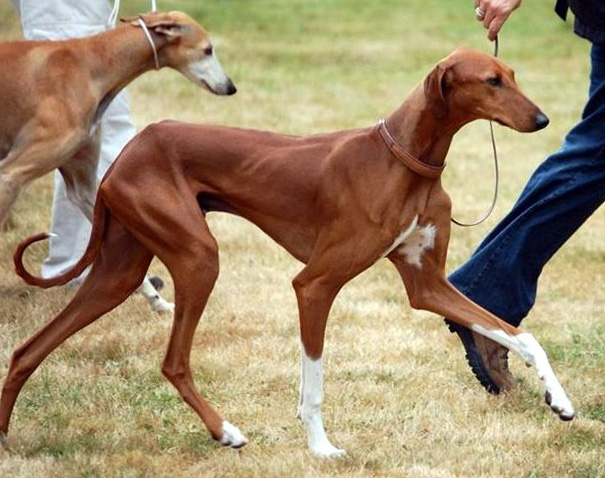
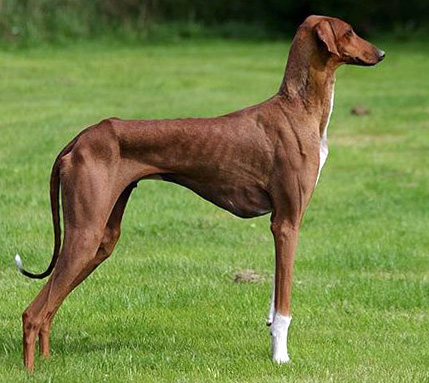
Particularly leggy and elegant, the Azawakh sighthound gives a general impression of great fineness. His bone structure and musculature is transparent beneath fine and lean tissues (skin). This sighthound presents itself as a rangy dog whose body fits into a rectangle with its longer sides in vertical position.
IMPORTANT PROPORTIONS:
- Length of body/height at the withers = 9:10. This ratio may be slightly superior in the bitches.
- Height of chest/height at the withers = about 4:10.
- Length of muzzle/length of head = 1:2.
- Width of skull/length of head = 4:10.
BEHAVIOUR AND TEMPERAMENT
Quick, attentive, distant, reserved with strangers and may even be savage, but he can be gentle and affectionate with those he is willing to accept.
HEAD
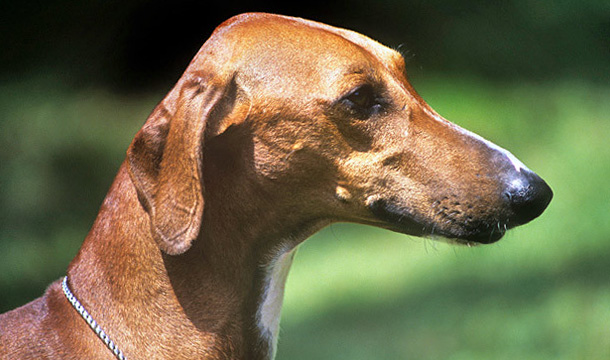
Long, fine, lean and chiselled, rather narrow, without excess.
CRANIAL REGION
The skull is almost flat, rather elongated. The width of the skull must definitely be inferior to half the length of the head. The directions of the axes of the skull and the muzzle are often slightly divergent towards the front. The superciliary arches and the frontal furrow are slightly marked. On the other hand, the occipital crest is clearly protruding and the occipital protuberance marked.
Stop: Very slightly marked.
FACIAL REGION:
Nose: Nostrils well opened. The nose is either black or brown.
Muzzle: Long, straight, fine towards the front without exaggeration.
Jaws: Long and strong.
Cheeks: Flat.
Teeth: Scissor bite.
Eyes: Almond shaped, quite large. Their colour is dark or amber. Eyelids pigmented.
Ears: Set quite high. They are fine, always drooping and flat, quite wide at the base, close to the skull, never a “rose ear”. Their shape is that of a triangle with a slightly rounded tip. Their base raises when the hound is attentive.
NECK:
Good reach of neck which is long, fine and muscular, slightly arched. The skin is fine and does not form a dewlap.
BODY
Topline: Nearly straight, horizontal or rising towards the hips.
Withers: Quite prominent.
Loin: Short, lean and often slightly arched.
Hipbones: Distinctly protruding and always placed at an equal or superior height to the height of the withers.
Croup: Oblique without accentuated slant.
Forechest: Not very wide.
Chest: Well developed in length, deep but without reaching elbow level. It is not very wide but must have enough space for the heart, so, the sternal region of the chest must not abruptly become narrow.
Ribs: Long, visible, slightly and evenly curved down to the sternum.
Underline: The sternal arch is accentuated and joined without abruptness to the belly which tucked up very high below the lumbar arch.
Tail: Set low, long, thin, lean and tapered. Is covered with the same type of hair as that of the body and has a white brush at its extremity. Is carried hanging with the tip slightly raised, but when the dog is excited, it can be carried above the horizontal.
QUARTERS
FOREQUARTERS:
Seen as a whole: Long, fine, almost entirely vertical; set perfectly well-set.
Shoulders: Long, lean and muscular and only slightly slanting seen in profile.
The scapulo-humeral angle is very open (about 130°).
Feet: Rounded shape, with fine and thighly closed toes; the pads are pigmented.
HINDQUARTERS:
Seen as a whole: Long and lean; legs perfectly vertical.
Thighs: Long with prominent and lean muscles. The coxo-femoral angle is very open (about 130°).
Stifle: The femoro-tibial angle is very open (about 145°).
Hock: Hockjoint and hock are straight and lean, without dewclaws.
Feet: Round shaped – Pads are pigmented.
GAIT – MOVEMENT: Always very supple (lissom) and with particularly high action at the trot and the walk. The gallop is bouncy. The Azawakh gives a great impression of lightness, even elasticity. The movement is an essential point of the breed.
SKIN: Fine, tight over the whole of the body.
COAT
Hair: Short, fine, down to none on the belly.
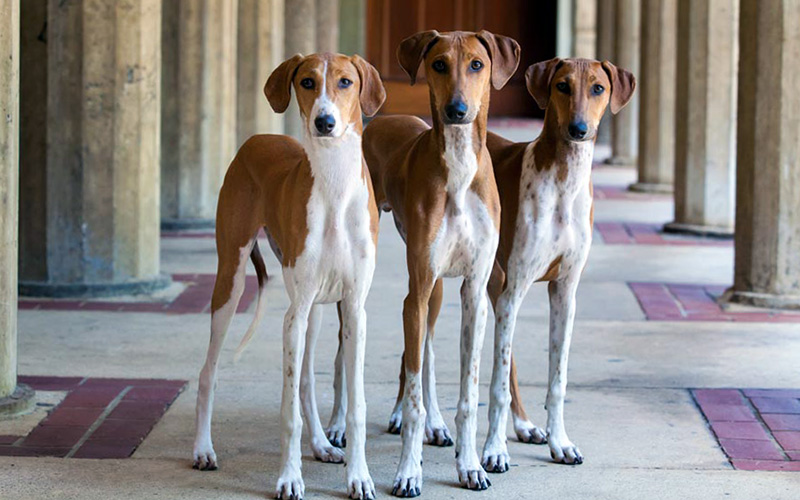
Colour: Fawn with flecking limited to the extremities. All shades are admitted from light sable to dark fawn. The head may or may not have a black mask and the blaze is very inconsistent. The coat has a white bib and a white brush at the tip of the tail.
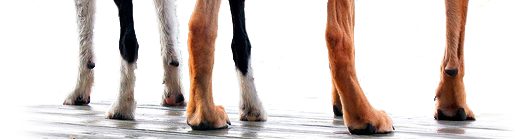
Each of the four limbs must have compulsorily a white “stocking”, at least in shape of a trace on the feet. The black brindling is admitted.
SIZED AND WEIGHT
Height at the withers: Dogs: between 64 and 74 cm
Bitches: between 60 and 70 cm
Weight: Dogs: about 20 – 25 kg, Bitches: about 15 – 20 kg.
FAULTS
Any departure from the foregoing should be considered a fault and the seriousness of which shall be penalised in exact proportion to its degree.
- General appearance: heavy.
- Body too long.
- Skull too wide.
- Accentuated Stop.
- Hipbones placed distinctly lower than the withers.
- Distinct depigmentation of the nose.
ELIMINATING FAULTS
- Lack of type (in particular when showing a recent crossing with another breed).
- Size out by more than 3 cm from the standard measures.
- Strong non-accidental anatomical deformation.
- Disabling anomaly not acquired.
- All obvious redhibitory vices.
- Ribs curving in at the base of the chest which thus takes on the look of a “violin box”.
- Upper or lower prognathism.
- Harsh or semi-long coat.
- Coat not conforming to the standard.
- Absence of any white marking at the extremity of one or more limbs.
- Light eye: i.e. bird of prey eyes.
- Timid character, panicky or aggressive with attack.
N.B.: Males should have two apparently normal testicles fully descended into the scrotum.
Photos and pictures of Azawakh: