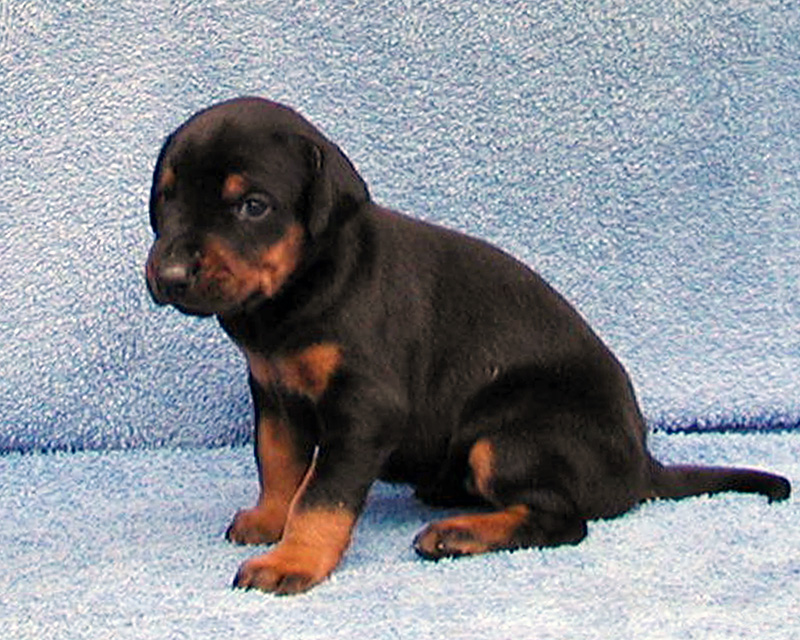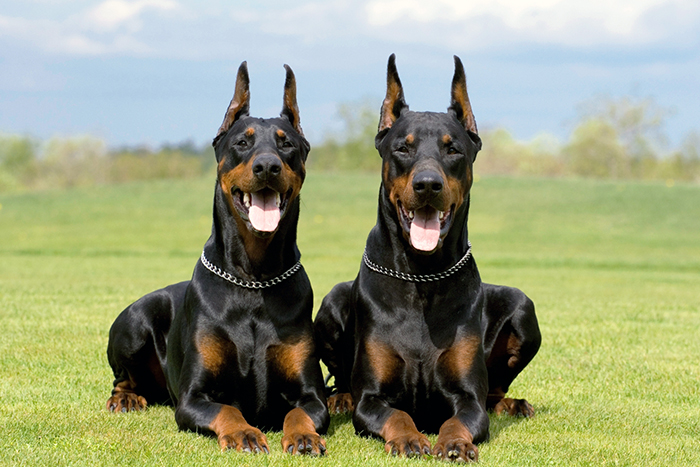
Dobermann
Dobermann: Temperament, Care, Health and Everyday Life
The Dobermann is an athletic, intelligent and highly trainable working breed developed in Germany. Originally bred by Friedrich Louis Dobermann, the breed became known for its work as a guard and police dog and is today used as a companion, protection and working dog.
A well-bred Dobermann combines physical power and athletic ability with a strong attachment to its family. These dogs are typically attentive to their surroundings, eager to work and closely connected to their owners. However, their intelligence, energy and protective instincts mean that appropriate training and socialisation are particularly important.
The Dobermann is not simply a dog that needs physical exercise. It also needs mental stimulation, close human contact and clear guidance. Prospective owners should therefore consider whether their lifestyle can meet the breed’s physical, emotional and training requirements before choosing a Dobermann.
How big does a Dobermann get?
The Dobermann is a medium-to-large, powerful and athletic dog. According to the breed standard, adult males measure approximately 68 to 72 cm at the withers and weigh around 40 to 45 kg. Females generally measure between 63 and 68 cm and weigh approximately 32 to 35 kg.
The ideal Dobermann should appear strong and muscular without being excessively heavy. Its build should remain elegant, balanced and athletic.
Individual weight can vary depending on height, sex, age and body condition. Owners should focus on maintaining a healthy physique rather than attempting to make the dog as large or muscular as possible.
How long do Dobermanns live?
Many Dobermanns live approximately 10 to 13 years, although individual lifespan can vary considerably according to genetics, health and lifestyle.
Health screening and responsible breeding are particularly important in this breed because some inherited conditions can significantly affect both quality of life and longevity.
Prospective owners should ask breeders about the health and lifespan of related dogs and request documentation of relevant health examinations performed on breeding animals.
What is the temperament of a Dobermann?
The typical Dobermann is intelligent, attentive, confident and strongly attached to its family. The breed standard calls for a friendly and calm dog with courage, good working ability and a close connection to its owner.
Dobermanns are often highly aware of their environment and may quickly notice unfamiliar people, sounds or changes around the home. Their natural alertness is one reason the breed has historically been successful in protection and police work.
However, a stable Dobermann should not be unnecessarily aggressive, fearful or uncontrollably reactive. Confidence and the ability to remain manageable in everyday situations are essential characteristics.
Temperament depends on genetics, early development, socialisation, training and individual experience. Choosing a responsible breeder who prioritises stable temperament is therefore particularly important.
Are Dobermanns good family dogs?
A well-bred and properly socialised Dobermann can be an exceptionally devoted family companion. Many develop very strong relationships with their owners and want to participate in almost every aspect of family life.
The breed is often described as a “velcro dog” because many individuals prefer remaining physically close to their favourite people. A Dobermann may follow its owner from room to room and can be happiest when included in everyday activities.
This close attachment means that the breed is generally not suitable for being kept primarily outside or separated from the household. A Dobermann should live as part of the family.
Are Dobermanns good with children?
Many well-socialised Dobermanns can be affectionate and gentle with children in their own families. The breed standard specifically describes devotion to the family and affection towards children as desirable characteristics.
However, the Dobermann is a strong, athletic and energetic dog. Young dogs in particular may accidentally knock over small children during excited play.
Children should be taught to respect the dog’s boundaries and should never disturb it while sleeping or eating. Interactions between dogs and young children should always be supervised by an adult.
Careful socialisation is especially important in busy family households where children frequently bring unfamiliar friends into the home.
Do Dobermanns get along with other dogs?
Many Dobermanns can live successfully with other dogs, but individual compatibility varies considerably. Genetics, sex, socialisation and previous experiences can all influence behaviour towards other dogs.
Early socialisation should expose a puppy to stable and appropriate canine companions. The goal should be to teach calm and socially competent behaviour rather than expecting the dog to play with every unfamiliar dog.
Some adult Dobermanns may become selective about their canine companions. Introductions between adult dogs should therefore be controlled and gradual.
Can Dobermanns live with cats and other pets?
Dobermanns can live successfully with cats, particularly when raised together or introduced carefully. However, individual prey drive varies, and some dogs may be strongly interested in chasing moving animals.
A Dobermann that lives peacefully with a familiar household cat may still chase unfamiliar cats outdoors. Owners should not assume that behaviour towards one animal will automatically apply to all others.
Introductions should be gradual and supervised, and cats should have access to safe areas where the dog cannot follow them.
Are Dobermanns easy to train?
The Dobermann is generally highly trainable and often enjoys learning and working with its owner. Intelligence, attentiveness and responsiveness have historically made the breed suitable for demanding working roles.
However, intelligence does not mean that training happens automatically. A poorly trained Dobermann can quickly develop unwanted behaviours, particularly if it lacks appropriate mental and physical stimulation.
Positive, structured and consistent training is generally the most effective approach. Training should provide clear expectations while rewarding desired behaviour.
Harsh or unnecessarily confrontational methods can damage trust and may create additional behavioural problems. A confident working breed does not require aggressive handling to learn reliable behaviour.
How important is socialisation for a Dobermann?
Early and thoughtful socialisation is particularly important for the Dobermann. Because the breed is naturally alert and attentive to its surroundings, puppies should learn that unfamiliar people, environments and everyday situations do not automatically represent a threat.
Good socialisation does not mean forcing a puppy to interact with everyone. The goal is to develop calm confidence and the ability to remain neutral and manageable in different situations.
Puppies should gradually experience different people, friendly dogs, traffic, public environments, household sounds, veterinary handling and other aspects of normal life.
Socialisation should continue throughout adolescence, as behaviour and confidence can change as the dog matures.
Is a Dobermann naturally protective?
The Dobermann was historically developed as a protection and working dog, and many individuals have a natural tendency to be watchful and protective of their home and family.
However, owners should not attempt to encourage uncontrolled aggression or suspicious behaviour. A stable protection-oriented dog should remain under control and be capable of distinguishing normal everyday situations from genuine threats.
Most family-owned Dobermanns do not require specialised protection training. If an owner wishes to participate in protection dog sports or professional working disciplines, training should be conducted under experienced and responsible supervision.
Do Dobermanns need professional protection training?
No. A Dobermann does not need protection training simply because of its breed. For the average family dog, excellent obedience, social stability and reliable everyday behaviour are considerably more important.
Poorly conducted protection training can create serious behavioural problems. Encouraging defensive or aggressive responses without professional knowledge is inappropriate and potentially dangerous.
Owners interested in structured working sports should seek qualified clubs or trainers with experience in working breeds and an emphasis on control, stability and responsible training.
Can a Dobermann be trusted off lead?
Many Dobermanns can develop a reliable recall because they are generally attentive to their owners and highly trainable. However, off-lead reliability depends on the individual dog and the quality of training.
Wildlife, unfamiliar dogs and other distractions can still affect behaviour. Recall should therefore be developed gradually and practised under increasing levels of distraction.
In unsafe environments, near traffic or where local regulations require dogs to remain on a lead, owners should use appropriate physical control regardless of how reliable the dog’s recall normally appears.
Can a Dobermann be left alone?
Dobermanns often form exceptionally close attachments to their owners and may find prolonged separation difficult. The breed is generally not ideal for a lifestyle in which the dog is routinely left alone for most of the day.
However, learning to remain alone calmly is an important life skill. Puppies should be introduced gradually to short periods of separation from an early age.
Individual tolerance varies. Some adult Dobermanns can remain alone comfortably for reasonable periods, while others may be more prone to separation-related stress.
Physical exercise alone does not necessarily prevent separation problems. Gradual training and emotional independence are equally important.
Are Dobermanns suitable for first-time dog owners?
A Dobermann can be successfully owned by a committed and well-prepared first-time owner, but the breed is generally more demanding than many conventional companion breeds.
Its combination of intelligence, strength, energy, sensitivity and natural alertness requires consistent training and responsible socialisation.
A first-time owner should be willing to learn about canine behaviour, attend appropriate training classes and provide sufficient mental and physical activity throughout the dog’s life.
Someone looking for a very low-maintenance dog that requires little training may find the Dobermann unsuitable.
How much exercise does a Dobermann need?
The Dobermann is an athletic and active working breed that generally requires considerably more exercise than a typical low-energy companion dog.
Healthy adults benefit from substantial daily physical activity. This may include brisk walks, controlled running, hiking, structured play and other appropriate activities.
Simply allowing a Dobermann into a garden is usually insufficient. The breed generally benefits from interactive exercise that involves the owner.
The exact amount depends on age, health and individual temperament. Exercise should be adapted carefully during puppyhood because excessive repetitive impact can place unnecessary stress on developing joints.
How much mental stimulation does a Dobermann need?
Mental stimulation is particularly important for this intelligent working breed. Physical exercise alone may not satisfy a Dobermann that has little opportunity to use its brain.
Obedience training, scent work, tracking, problem-solving games and structured dog sports can provide valuable mental challenges.
Regular short training sessions incorporated into everyday life can be more beneficial than occasionally attempting to exhaust the dog through intense physical activity.
A bored Dobermann may create its own activities, which can include destructive or unwanted behaviours. Providing appropriate mental outlets is therefore an important part of responsible ownership.
Which dog sports are suitable for Dobermanns?
The Dobermann’s athletic ability, intelligence and willingness to work make the breed suitable for a wide range of activities. Depending on the individual dog, possible options include obedience, tracking, scent work, mantrailing, agility and structured working-dog sports.
Not every Dobermann needs to participate in competitive sport. However, many benefit from having regular activities that provide both mental and physical challenges.
High-impact activities should be introduced gradually and only when the dog’s physical development is sufficiently advanced.
Can a Dobermann live in an apartment?
A Dobermann can live successfully in an apartment if its physical, mental and social needs are consistently met. The size of the home is often less important than the quality of the dog’s daily routine.
However, apartment living requires a committed owner who provides sufficient exercise and mental stimulation outside the home.
The dog’s natural alertness should also be considered. Training can help prevent excessive reactions to neighbours, corridor noises and other everyday activity in shared buildings.
Do Dobermanns bark a lot?
Dobermanns are naturally alert and may bark when they detect unusual activity. However, they are not necessarily excessive barkers when appropriately exercised and trained.
Because the breed pays close attention to its environment, some individuals may become overly reactive to sounds or movement if calm behaviour is not encouraged.
Persistent barking may indicate boredom, stress, insufficient stimulation or an established behavioural habit and should be addressed according to the underlying cause.
Can Dobermanns tolerate cold weather?
The Dobermann has a short coat without the insulating undercoat found in many cold-weather breeds. As a result, many individuals are sensitive to low temperatures, particularly when standing still or spending extended periods outdoors.
In cold climates, a well-fitting dog coat may be useful during winter walks. Dogs should also have access to a warm indoor environment and should not be expected to live outside in cold conditions.
Individual tolerance varies depending on temperature, activity level and weather conditions.
Can Dobermanns tolerate hot weather?
The Dobermann’s short coat generally makes warm conditions easier to manage than for heavily coated breeds, but Dobermanns can still overheat during intense exercise.
During hot weather, demanding physical activity should be moved to cooler parts of the day. Fresh water and access to shade should always be available.
Owners should watch for signs of heat-related illness, including excessive panting, weakness, confusion and collapse.
How much grooming does a Dobermann need?
The Dobermann is relatively easy to maintain in terms of coat care. Its short, smooth coat generally requires only regular light brushing to remove loose hair and surface dirt.
Bathing is usually necessary only when the dog is genuinely dirty. Routine care should also include nail trimming, ear checks and dental hygiene.
Because the coat is short, skin changes, lumps or injuries can often be noticed relatively easily during regular handling and grooming.
Do Dobermanns shed?
Yes. Dobermanns shed throughout the year despite having a very short coat. The amount is generally moderate, although individual dogs vary.
Their short hairs can become embedded in fabrics and furniture. Regular brushing can help remove loose hair but will not eliminate shedding completely.
What should a Dobermann eat?
A Dobermann should receive a complete and balanced diet appropriate to its age, size, activity level and health. Highly active working or sporting dogs may have different nutritional requirements from less active family companions.
Portions should be adjusted to maintain a lean and athletic body condition. Excess weight places unnecessary stress on joints and may negatively affect overall health.
Puppies require appropriate nutrition to support controlled growth and development. Individual dietary requirements should be discussed with a veterinarian when necessary.
What health problems are common in Dobermanns?
Dobermanns can be predisposed to several inherited and acquired health conditions. One of the most important concerns in the breed is dilated cardiomyopathy, commonly known as DCM, a serious disease affecting the heart muscle.
Other potential health concerns include von Willebrand disease, cervical vertebral instability sometimes referred to as Wobbler syndrome, hip dysplasia and certain thyroid disorders.
The prevalence of individual conditions varies between dogs and breeding lines. Prospective owners should ask breeders which health examinations and genetic tests are performed and request documentation of relevant results.
Because some heart conditions can develop without obvious early symptoms, owners should discuss appropriate cardiac screening with their veterinarian.
What is dilated cardiomyopathy in Dobermanns?
Dilated cardiomyopathy is a disease in which the heart muscle becomes weakened and the heart may become enlarged, reducing its ability to pump blood effectively.
Some affected dogs may initially show few or no obvious symptoms. As the condition progresses, possible signs can include reduced exercise tolerance, weakness, coughing, breathing difficulties, fainting or collapse.
Because Dobermanns have a recognised predisposition to DCM, cardiac health is an especially important consideration for owners and breeders. Veterinary screening may include examinations such as echocardiography and ambulatory ECG monitoring depending on the individual situation and veterinary recommendation.
Any unexplained collapse, fainting or breathing difficulty requires prompt veterinary assessment.
How expensive is it to own a Dobermann?
The cost of owning a Dobermann includes quality food, routine veterinary care, preventive healthcare, training, equipment and insurance where applicable.
Training expenses should be considered part of the normal cost of responsible ownership rather than an optional extra, particularly during puppyhood and adolescence.
Health monitoring can also represent a significant expense, especially if regular cardiac screening or treatment for chronic conditions becomes necessary.
Prospective owners should therefore consider the total lifetime cost of the dog rather than focusing only on the purchase price of a puppy.
Who is a Dobermann suitable for?
The Dobermann may be an excellent choice for an active owner who wants an intelligent, athletic and highly involved companion.
The ideal owner enjoys training and interacting with their dog and is willing to provide both physical exercise and regular mental challenges.
The breed is particularly well suited to people who appreciate a dog that forms a strong bond with its family and naturally pays close attention to its surroundings.
Who should not get a Dobermann?
A Dobermann may not be suitable for someone who wants a low-energy or highly independent dog requiring minimal interaction and training.
The breed is also a poor choice for a lifestyle in which the dog will routinely spend most of the day alone without sufficient physical activity or mental stimulation.
People who are unwilling to invest time in socialisation and consistent training should consider a less demanding breed.
Prospective owners should also understand the breed’s potential health risks and be prepared for the financial responsibilities associated with appropriate preventive screening and veterinary care.
What are the main advantages and disadvantages of a Dobermann?
The Dobermann’s principal strengths include intelligence, trainability, athletic ability and an exceptionally strong bond with its family. The breed can be a highly versatile companion for owners who enjoy an active lifestyle and regular training.
Potential challenges include high requirements for mental stimulation, the need for careful socialisation and difficulty tolerating prolonged separation in some individuals. The breed’s natural alertness also requires responsible management rather than encouragement of uncontrolled protective behaviour.
Health risks, particularly the breed’s predisposition to serious cardiac disease, are another important consideration.
Is a Dobermann the right dog for you?
The Dobermann is an intelligent, athletic and deeply devoted working breed that can become an exceptional companion in the right home. Its combination of trainability, physical ability and strong attachment to its owner makes the breed particularly rewarding for people who enjoy actively working with their dogs.
However, a Dobermann requires more than occasional walks and basic care. Appropriate socialisation, consistent training, mental stimulation and regular physical activity are essential parts of responsible ownership.
Prospective owners should also understand that natural alertness should be balanced by stability and control. A well-adjusted Dobermann should be capable of functioning confidently in everyday society rather than viewing ordinary situations as threats.
Health should also play an important role in the decision. Choosing a responsible breeder and discussing appropriate preventive screening with a veterinarian are particularly important because of the serious inherited conditions that can affect the breed.
For an owner who can provide close companionship, thoughtful training, sufficient activity and responsible healthcare, the Dobermann can be an exceptionally loyal, capable and rewarding partner.
“`
Frequently Asked Questions About Dobermanns
How big does a Dobermann get?
Adult males generally measure 68 to 72 cm at the withers and weigh approximately 40 to 45 kg. Females usually measure 63 to 68 cm and weigh around 32 to 35 kg.
How long does a Dobermann live?
Many Dobermanns live approximately 10 to 13 years, although individual lifespan varies according to genetics, health and lifestyle.
Are Dobermanns good family dogs?
Yes. Well-bred and properly socialised Dobermanns are often deeply devoted to their families and prefer being closely involved in everyday family life.
Are Dobermanns good with children?
Many Dobermanns can be affectionate and gentle with children, particularly within their own families. Interactions with young children should always be supervised.
Are Dobermanns naturally protective?
Many Dobermanns are naturally alert and protective of their home and family, but a stable dog should remain controllable and should not display unnecessary aggression.
Do Dobermanns need protection training?
No. The average family Dobermann does not require protection training. Reliable obedience, socialisation and stable everyday behaviour are considerably more important.
How much exercise does a Dobermann need?
Healthy adult Dobermanns generally need substantial daily physical activity combined with regular mental stimulation and training.
Can a Dobermann live in an apartment?
Yes. A Dobermann can adapt to apartment living if its considerable exercise, mental stimulation and social needs are consistently met.
Can a Dobermann be left alone?
Dobermanns can learn to remain alone for reasonable periods, but many form very strong bonds with their owners and are not suited to routinely spending most of the day alone.
Are Dobermanns easy to train?
Dobermanns are generally highly intelligent and trainable. They respond particularly well to structured, consistent and reward-based training.
Do Dobermanns tolerate cold weather?
Many Dobermanns are sensitive to cold because their short coat lacks a substantial insulating undercoat. Protective clothing may be useful during cold winter weather.
What health problems are common in Dobermanns?
Important health concerns can include dilated cardiomyopathy, von Willebrand disease, cervical vertebral instability, hip dysplasia and certain thyroid disorders.
Are Dobermanns suitable for first-time owners?
A committed first-time owner can successfully live with a Dobermann, but the breed requires consistent training, careful socialisation and substantial physical and mental activity.
“`
Dobermann pictures ➜
ORIGIN:
Germany.
APPLICATION:
Companion, protection and working dog.
BRIEF HISTORICAL SUMMARY
The Dobermann is the only German breed which bears the name of its original breeder, Friedrich Louis Dobermann (02.01.1834 – 09.06.1894).
Das kupieren von Ohr und Rute, heute in vielen Ländern verboten …He was believed to be a tax collector, offal abbatoir manager (knacker) and a part time dog catcher, legally able to catch all stray dogs. He bred with animals from this reservoir that were particularly sharp. The so called “butcher’s dogs” which were already considered a relatively pure breed at that time, played a most important role in the origination of the Dobermann breed. These dogs were an early type of Rottweiler, mixed with a type of shepherd which existed in “Thüringen” as a black dog with rust red markings. Herr Dobermann bred with this mixture of dogs in the Eighteen Seventies. Thus he obtained “his breed”: not only alert, but highly protective working and housedogs. They were often used as guard and police dogs. Their extensive use in police work led to the nickname “Gendarme dog”. They were used in hunting to control large vermin. In these circumstances it was a matter of course that the Dobermann was recognized officially as a Police Dog by the beginning of the century.
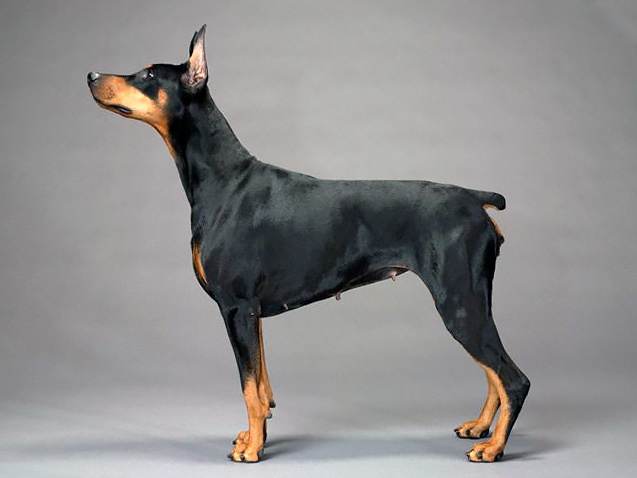
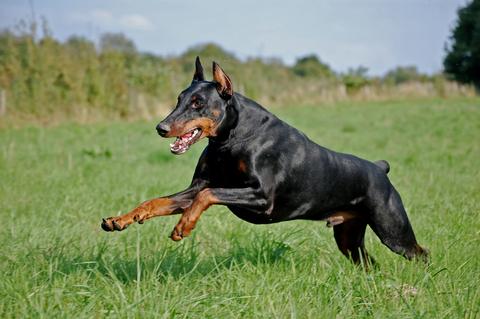
The Dobermann breed requires a medium sized, powerful, muscular dog. Despite his substance he shall be elegant and noble, which will be evident in his body line. He must be exceptionally suitable as a companion, protection and working dog and also as as family dog.
GENERAL APPEARANCE
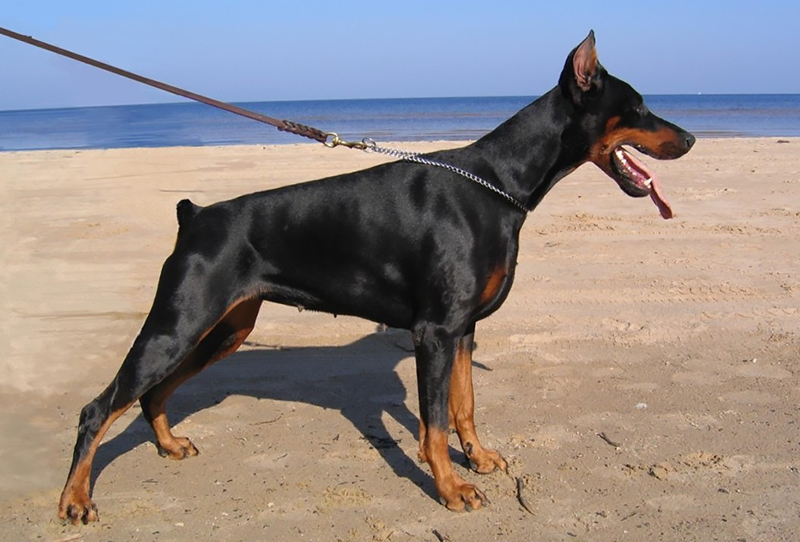
The Dobermann is of medium size, strong and muscularly built. Through the elegant lines of its body, its proud stature, and its expression of determination, it conforms to the ideal picture of a dog.
IMPORTANT PROPORTIONS:
The body of the Dobermann appears to be almost square, particularly in males. The length of the body measured from the point of the shoulder to the point of the buttock shall not be more than 5% longer than the height from the withers to the ground in males, and 10% in females.
BEHAVIOUR AND TEMPERAMENT
The disposition of the Dobermann is friendly and calm; very devoted to the family it loves children. Medium temperament and medium sharpness (alertness) is desired. A medium threshold of irritation is required with a good contact to the owner. Easy to train, The Dobermann enjoys working, and shall have good working ability, courage and hardness. The particular values of self confidence and intrepidness are required, and also adaptability and attention to fit the social environment.
HEAD
CRANIAL REGION: Strong and in proportion to the body. Seen from the top the head is shaped in the form of a blunt wedge. Viewed from the front the crown line shall be almost level and not dropping off to the ears. The muzzle line extends almost straight to the top line of the skull which falls, gently rounded, into the neck line. The superciliary ridge is well developed without protruding. The forehead furrow is still visible. The Occiput shall not be conspicuous. Seen from the front and the top the sides of the head must not bulge. The slight bulge between the rear of the upper jawbone and the cheek bone shall be in harmony with the total length of the head. The head muscles shall be well developed.
Stop: Shall be slight but visibly developed.
FACIAL REGION
Nose: Nostrils well developed, more broad than round, with large openings without overall protrusion. Black – on black dogs; on brown dogs, corresponding lighter shades.
Muzzle: The muzzle must be in the right proportion with the upper head and must be strongly developed. The muzzle shall have depth. The mouth opening shall be wide, reaching to the molars. A good muzzle width must also be present on the upper and lower incisor area.
Flews: They shall be tight and lie close to the jaw which will ensure a tight closure of the mouth. The pigment of the gum to be dark; on brown dogs a corresponding lighter shade.
Jaw/Dentition/Teeth: Powerful broad upper and under jaw, scissor bite, 42 teeth correctly placed and normal size.
Eyes: Middle sized, oval and dark in colour. Lighter shades are permitted for brown dogs. Close lying eyelids. Eyelids shall be covered with hair. Baldness around the rim of the eye is highly undesirable.
Ears: The ear, which is set high, is carried erect and cropped to a length in proportion to the head. In a country where cropping is not permitted the uncropped ear is equally recognized. (Medium size preferred and with the front edge lying close to the cheeks).
NECK: The neck must have a good length and be in proportion to the body and the head. It is dry and muscular. Its outline rises gradually and is softly curved. Its carriage is upright and shows much nobility.
BODY
Withers: Shall be pronounced in height and length, especially in males and thereby determine the slope of the topline rising from the croup to the withers.
Back: Short and tight, of good width and well muscled.
Loin: Of good width and well muscled. The bitch can be slightly longer in loin because she requires space for suckling.
Croup: It shall fall slightly, hardly perceptable from sacrum to the root of the tail, and appears well rounded, being neither straight nor noticeably sloping, of good width and well muscled.
Chest: Length and depth of chest must be in the right proportion to the body length. The depth with slightly arched ribs should be approximately 50% the height of the dog at the withers. The chest has got a good width with especially well developped forechest.
Underline: From the bottom of the breastbone to the pelvis the underline is noticeably tucked up.
Tail: It is high set and docked short whereby approximately two tail vertebrae remain visible. In countries where docking is legally not permitted the tail may remain natural.
LIMBS
FOREQUARTERS
General: The front legs as seen from all sides are almost straight, vertical to the ground and strongly developed.
Shoulders:The shoulder-blade lies close against the chest, and both sides of the shoulder-blade edge are well muscled and reach over the top of the Thoracic Vertebra, slanting as much as possible and well set back. The angle to the horizontal is approximately 50%.
Elbow: Close in, not turned out.
Lower Arm: Strong and straight. Well muscled. Length in harmony with the whole body.
Carpus: Strong.
Metacarpus: Bones strong. Straight seen from the front. Seen from the side, only slightly sloping, maximum 10o.
Front Foot: The feet are short and tight. The toes are arched towards the top (cat like). Nails short and black.
HINDQUARTERS
General: Seen from the back the Dobermann looks, because of his well developed pelvic muscles in hips and croup, wide and rounded off. The muscles running from the pelvic towards the upper and lower thigh result in good width development, as well as in the upper thigh area, in the knee joint area and at the lower thigh. The strong hind legs are straight and stand parallel.
Upper Thigh: Good length and width, well muscled. Good angulation to the hip joint. Angulation to the horizontal approximately between 80o to 85o.
Knee: The knee joint is strong and is formed by the upper and lower thigh as well as the knee cap. The knee angulation is approximately 130o.
Lower Thigh: Medium length and in harmony with the total length of the hindquarter.
Hock joint: Medium strength and parallel. The lower thigh bone is joined to the Metatarsal at the hock joint (Angle about 140o).
Metatarsus: It is short and stands vertical to the ground.
Hind Foot: Like the front feet, the toes of the back feet are short, arched and closed. Nails are short and black.
GAIT: The gait is of special importance to both the working ability as well as the exterior appearance. The gait is elastic, elegant, agile, free and ground covering. The front legs reach out as far as possible. The hind quarter gives far reaching and necessary elastic drive. The front leg of one side and back leg of the other side move forward at the same time. There should be good stability of the back, the ligaments and the joints.
<b>SKIN: The skin fits closely all over and is of good pigment.
COAT
HAIR: The hair is short, hard and thick. It lies tight and smooth and is equally distributed over the whole surface.
Undercoat is not allowed.
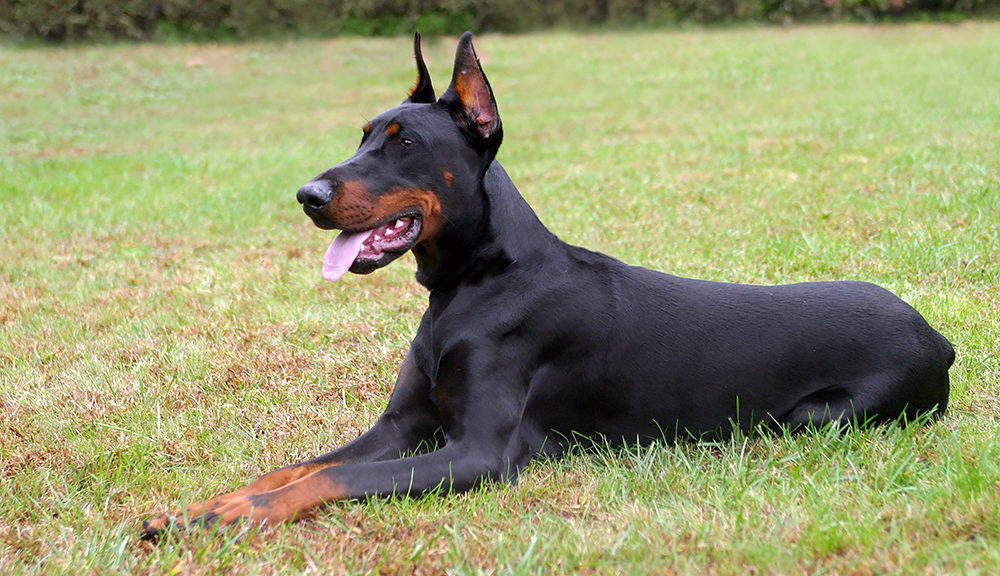
COLOUR: The colour is black or brown, with rust red clearly defined and clean markings. Markings on the muzzle, as a spot on the cheeks and the top of the eyebrow, on the throat, two spots on the forechest, on the metacarpus, metatarsus and feet, on the inside of the back thigh, on the arms and below the tail.
SIZE AND WEIGHT
SIZE: Height at the highest point of withers.
Males: 68 – 72 cm, Bitches: 63 – 68 cm, Medium size desirable.
WEIGHT: Males about 40 – 45 kg
Bitches about 32 – 35 kg
FAULTS
Any departure from the foregoing points should be considered a fault and the seriousness with which the fault should be regarded shlould be in exact proportion to its degree.
General Appearance: Reversal of sexual impression; little substance; too light; too heavy; too leggy; weak bones.
Head: Too heavy; too narrow; too short; too long; too much or too little stop; Roman nose; bad slope of the top line of the skull; weak underjaw; round or slit eyes; light eye; cheeks too heavy; loose flews; eyes too open or too deepset; ear set too high or too low; open mouth angle.
Neck: Slightly short; too short; loose skin around the throat; dewlap; too long (not in harmony); ewe neck.
Body: Back not tight; sloping croup; sway back; roach back; insufficient or too much spring of rib; insufficient depth or width of chest; back too long overall; too little forechest; tail set too high or too low; too little or too much tuck up.
Limbs: Too little or too much angulation front or hindquarters; loose elbow; deviations from the standard position and length of bones and joints; feet too close together or too wide apart; cow-hocks, spread hocks, close hocks; open or soft paws, crooked toes; pale nails.
Coat: Markings too light or not sharply defined; smudged markings; mask too dark; big black spot on the legs; chest markings hardly visible or too large; hair long, soft, curly or dull. Thin coat; bald patches; large tufts of hair particulary on the body; visible undercoat.
Character: Inadequate self confidence; temperament too high; sharpness too high; too high or too low a threshold of irritation.
Size: Deviation of size up to two centimetres from the standard should result in a lowering of the quality grading.
Gait: Wobbly; restricted or stiff gait; pacing.
DISQUALIFYING FAULTS
General: pronounced reversal of sexual impressions.
Eyes: Yellow eyes (bird of prey eye); wall eye.
Dentition: Overshot; level bite; undershot; missing teeth.
Coat: White spots; pronounced long and wavy hair; pronounced thin coat or large bald patches.
Character: Fearful, nervous and aggressive animals.
Size: Dogs which deviate more than two centimetres over or under the standard.
N.B.: Male animals should have two apparently normal testicles fully descended into the scrotum
Photos and pictures of Dobermann: